Septic Tank Clearing & Pumping – From 86K VND, On-Site in 15 Minutes

When your household suddenly faces slow-draining toilets, foul odors backing up, or continuous gurgling and bubbling in the sanitation system, these are urgent signs that your septic tank is overloaded. Calling a professional at this point is imperative. However, a common dilemma for most homeowners is: How do you accurately locate the septic tank under the floor to open its lid? Failure to precisely identify its location can turn a routine sanitation service into a “disaster,” forcing technicians to extensively excavate and damage your flooring in a blind search!
Do not panic. Drawing on practical experience accumulated from tens of thousands of households in the capital, the engineering team at Môi Trường Xanh will share detailed, smart, and precise methods for locating your septic tank, completely eliminating the need for haphazard drilling or cutting.
1. Why Is It Crucial to Precisely Locate the Septic Tank Lid?
Many households believe that pumping technicians simply need to insert a hose through the toilet drain. While vacuum pumping technology through the toilet bowl exists, the most effective method for thorough cleaning and complete sludge removal from the tank bottom is to open the septic tank lid.
- Preservation of Floor Structure: Avoids exploratory drilling and random demolition of tiles.
- Time Efficiency & Communication Clarity: Locating the lid from the outset significantly reduces service time from half a day to just 30 minutes, minimizing disruption and miscommunication.
- Prevention of Underground Pipe Damage: Incorrect exploratory digging can easily puncture underground water supply systems, leading to localized flooding.
2. 4 Smartest Methods to Locate Your Septic Tank (DIY at Home)
If your house was built long ago and you were not the original designer, sequentially apply these four deductive methods:
Method 1: Retrieve Architectural As-Built Drawings or Survey Plans
This is a classic method, achieving toàn diện accuracy. If your house was built from scratch or if you have access to its construction design documents, locate the ground floor (1st floor) plumbing and drainage system layout plan.
- On these blueprints, the wastewater treatment system is typically indicated as a cluster of 2 or 3 rectangular/square compartments located directly beneath the stairs, under the kitchen area, or in the front yard.
Method 2: Identify Based on Hydraulic Design Principles
Given the characteristic construction of tube houses (3-5 story townhouses) in Hanoi’s urban core, architects have limited options for burying septic tanks. You can narrow down the location based on these deductions:
- Principle of “Proximity to Ground Floor Restroom”: Most supply and drain pipes from restrooms on upper floors converge vertically. Therefore, the septic tank is often situated directly beneath the ground floor restroom or adjacent to the living room, facing the public sewer line.
- Underneath a U-shaped Staircase: An ideal, less-trafficked space that meets structural load-bearing standards.
Method 3: Recognize by Concealed Concrete Lids / Floor-Level Covers
In cases where the house foundation is meticulously finished, use a flashlight and carefully inspect the floor tiles near the restroom and kitchen areas:
- Typically, septic tank lids are square, approximately 40x40cm or 50x50cm.
- You might notice grout lines that differ significantly from the surrounding ones, or a small ring-shaped hole on the floor (like a water bottle cap, used for inserting a hook to lift the lid). That is likely the septic tank access cover!
Method 4: Visually Inspect the Vent Pipe’s Trajectory
A standard septic tank invariably has a small PVC vent pipe (ø27 or ø34 mm) extending upwards towards the roof or through a wall to an alleyway to release H2S gas. Walk to the edge of your house and observe where this small vent pipe descends directly into the ground; there’s a high probability that this marks a corner of the septic tank.
3. If You Cannot Locate It Yourself, Môi Trường Xanh Will Assist with Cutting-Edge Endoscopic Technology
There will be instances when all four methods prove ineffective because the floor is covered with thick tiles, or previous owners are unreachable. Do not rush to call for concrete demolition!
At the Môi Trường Xanh Environmental Sanitation Complex, we tackle “Lost Septic Tank” cases with two steps of Advanced Technology:
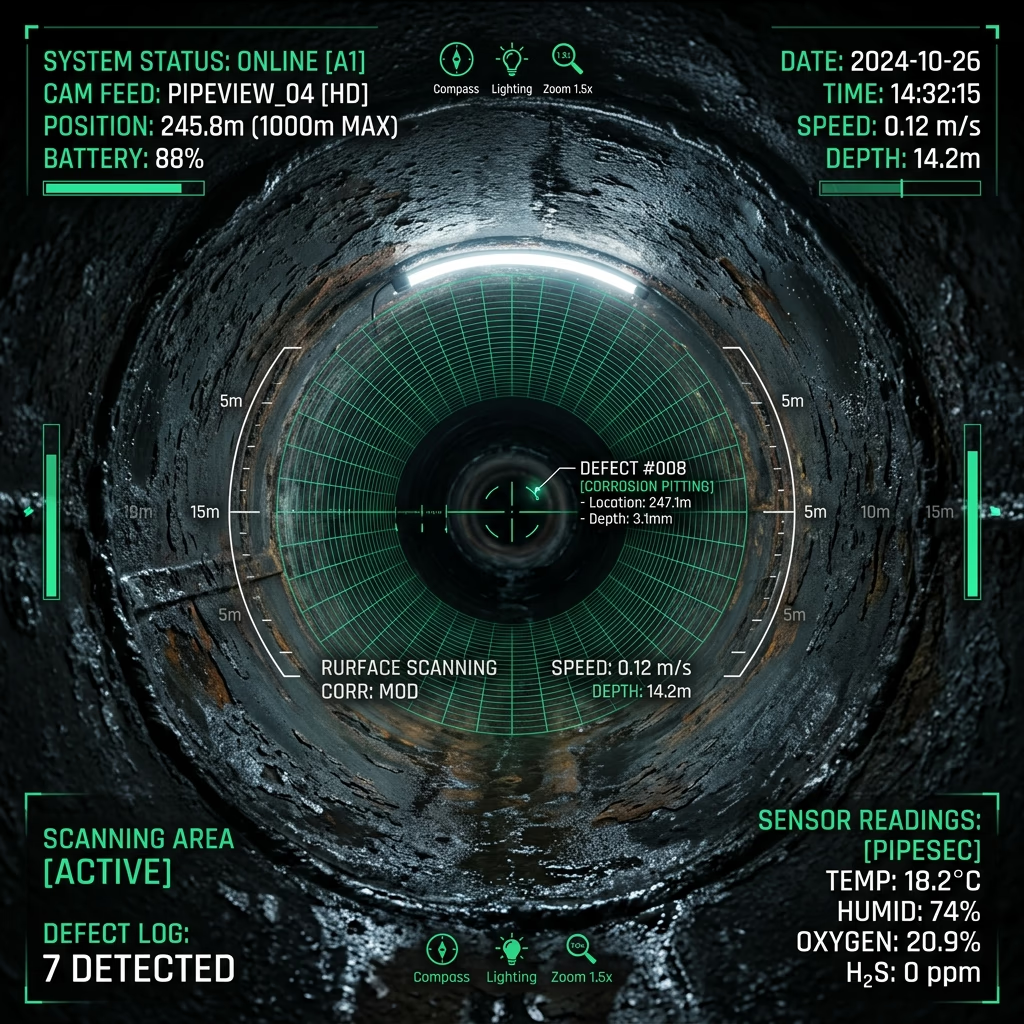
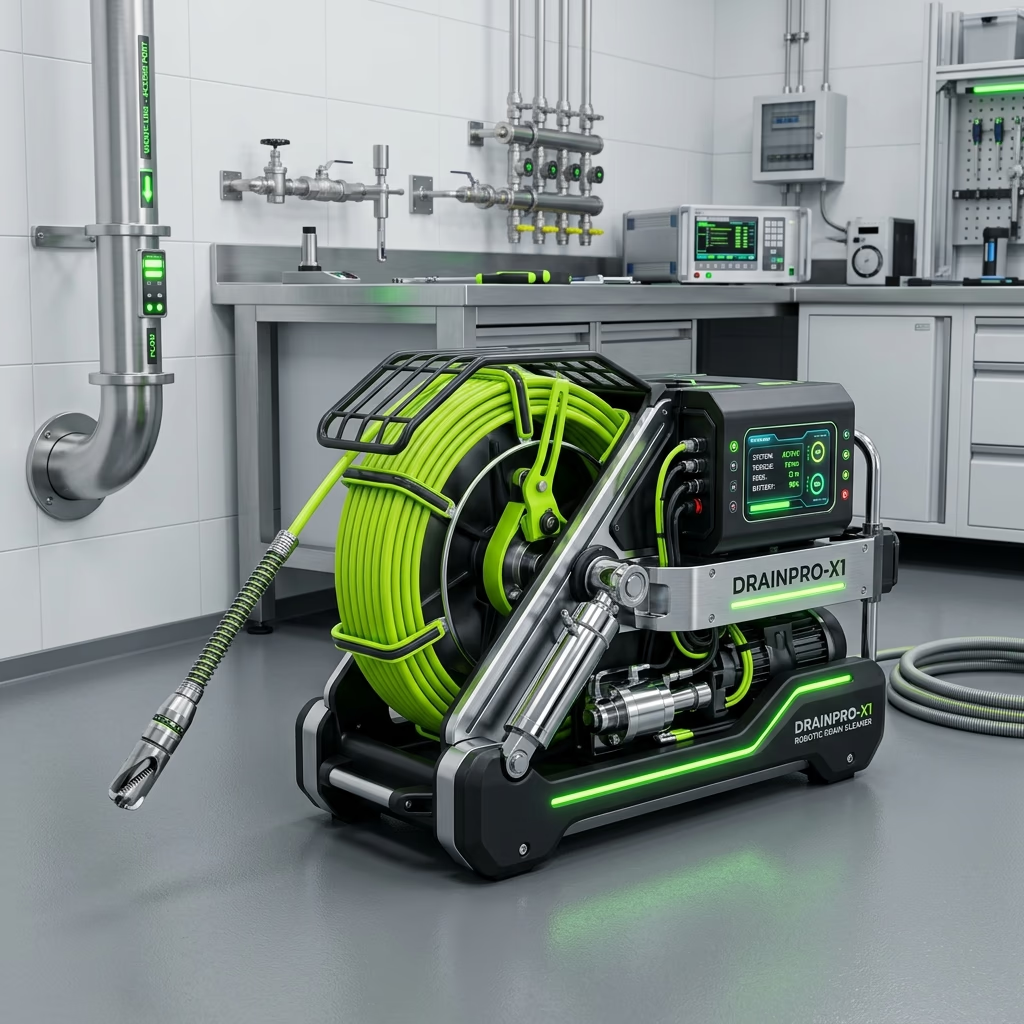
- Utilizing Flexible 360 HD Endoscopic Camera: Our technicians remove the ground floor toilet bowl and insert a specialized “Robot Snake Camera” device deep into the drainage pipe. The HUD screen meticulously tracks the pipe’s trajectory, indicating the perpendicular intersection point leading to the septic tank via coordinate mapping.
- Reactive Sonic Pulse Scanning: Employing a short-wave radar pulse detector to identify voids beneath up to 1 meter of concrete depth. Precisely delineating the septic tank lid’s boundaries within just 15 minutes.
All procedures are NON-INVASIVE, ensuring the homeowner’s floor remains toàn diện intact before the exact lid joint is precisely cut.
4. Post-Opening Advice for Regular Septic Maintenance
Once the septic tank has been arduously located and its lid opened, the crucial next step is to thoroughly pump out all accumulated dead biological sludge from the bottom. Do not opt for superficial services, as they will only lead to a second tank blockage. Môi Trường Xanh employs the Japanese Cyclone Vacuum Pumping method, guaranteeing pristine cleanliness. Upon completion, we advise installing an aesthetic access cover for easier rim removal during subsequent routine maintenance (every 3-5 years).
5. Frequently Asked Questions (FAQ) Regarding Septic Tank Location
1. Is there an additional fee for using the endoscopic camera to locate the septic tank?
If you book this service in conjunction with Môi Trường Xanh’s comprehensive pumping and clearing package, the endoscopic septic tank lid detection is entirely complimentary as part of our value-added utility bundle.
2. Is it true that older houses often placed septic tanks in the middle of the house to ward off bad feng shui (dragon’s vein)?
That was an outdated and problematic traditional belief. Currently, 90% of engineers recommend placing it near the front entrance, under the stairs, or adjacent to the restroom for optimal two-story odor ventilation. Therefore, searching in the middle of the living room is no longer a standard approach.
3. If wooden flooring is laid over tiles, how can the septic tank lid beneath the wooden floor be identified?
In this scenario, we must rely on predicted locations from architectural plans. Subsequently, we use penetrating localization waves to guide the homeowner in precisely removing the specific wooden floor panel, preventing damage to expensive wooden interiors in the surrounding area.
4. What if the septic tank lid is located beneath kitchen cabinets?
This is an extremely complex situation, quite common in renovated mini-apartments. The necessary approach is to use a high-pressure vacuum pumping system through the toilet bowl to preserve the kitchen cabinets, instead of dismantling the entire U-shaped kitchen layout. The suction power from Môi Trường Xanh’s centrifugal pumps is more than sufficient to handle this challenge.
5. What technical indicators guarantee toàn diện that tapping the floor signifies a septic tank?
When you tap the floor tiles with a rubber mallet or a flag pole handle, if the sound produced is distinctively hollow and reverberates with a ‘booming’ or ‘drumming’ quality, indicative of a large void beneath, the probability of it being the sedimentation compartment of the septic tank is very high.
6. Can I request an additional diagram or drawing after the pumping service for future reference?
Môi Trường Xanh’s technicians will gladly use a felt-tip pen to sketch the septic tank lid’s center coordinates directly onto paper or send it via Zalo to the homeowner, serving as a “legacy document” for maintenance cycles in future decades.
Being stuck with a fundamental question does not mean giving up. The nationwide hotline of Môi Trường Xanh is always ready to receive calls for consultation and to dispatch a team of technicians equipped with detectors to your home for the quickest and most reliable inspection. Don’t compromise your home when issues can be resolved with expertise and advanced technology!